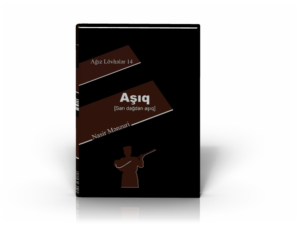
Oral Tablets (14)
Aşıq (sarı dağdan aşıq)
By Naser Manzuri
Language _in its essence_ carries the mysteries of the structure, concept as well as the meanings. Oral Tablets book series aims at the demystification of these mysteries. The opening of the encryptions that were generated by the existence of the ‘language -thought’ continuum is a giant leap in the field of cognitive studies.
The formation of the world reiterates itself in the language abstractly. So, language, despite the high complexity of the language, generally borrows its concept-structure system from the form of the world and adapts to it. Decryption of such a complex adaptation is not only feasible via linguistics but requires multi-disciplinary studies which avoid all cliches.
The author is glad to share his discoveries as he is not dogmatic about them.
Contents
Declaration
About this book
The essence of the book
Chapter 1: Where to begin?
‘Ay’ as a primary concept
Chapter 2: The features and phases of the identity of Ashiq
Chapter 3: Buta-receiving phase
Butiqa, Poetika
Chapter 4: Becoming an ‘Ozan’
Relation of ‘Ozan’ and ‘Ay’!
Chapter 5: Being an Ashiq
Chapter 6: Ay-likening (searching Günəş/The Sun)
Chapter 7: Az, Saz [s.az]
Chapter 8: Saz, Sar (Ashiq’s sar)
Sar
Chapter 9: Quest and the phrase ‘hanı’?
‘Hanı’ as the most mysterious term of the quest
Chapter 10: ‘Ashiq’ as a primary word
Chapter 11: Mountains, Mountains, and Mountains
(Black Mountains, Zigorats, Pyramids)
Chapter 12: To overcome
(to cook aş after the traveller)
Chapter 13: Infinitive, but Noun
(Yaş/Age, Yaşamaq/To Live, Başmaq/Shoes)
Chapter 14: Aşmaq, Aşırmaraq, Daşmaq, Daşırmaq
Chapter 15: Aş, Başmaq, Yaşmaq, Çaşmaq
The structure of the verb ‘Aşmaq’
Chapter 16: Atak Xamsa (In Memory of Ashiq Ali Sabahi)
Terms