Sound: [r]
Signifying:
-
-
-
-
- form/type (rare): –
- (functionally) active, dynamic
-
-
-
place of articulation: front of the tongue and back of the alveolar ridge/hard palate
manner of articulation: approximant
voiced/voiceless: voiced
Our studies show that the early sounds were of semiotic value. Therefore, we use signify semiotically (instead of sign) for the sounds. The semiotic value of the approximant sound [r] is:
[formally/typically] –
(functionally) active, dynamic, motional
Points with the sound [r] in the phonetic/phonemic system:
1. The signification conveyed by the sound [r] is directly related to action, dynamicity, and motion. This sound is not related to ‘form’ or ‘type’ of phenomena. Therefore, it never comes at the beginning [of a word] because the first sound of a word formation commonly signifies the form or type. In case of occurring at the beginning there would be a vowel sound preceding: [vowel + r]
Rza (name) → İrza
2. The sound [r] has had complexity with the sound [l] since the early phases of language and it is still possible to found. This complexity is due to the significations they convey.
[r] active, dynamic
[l] trans-, shifting, converting
Because of the above functionalities with both sounds their coming at the beginning of a word is rare in Türki since they can’t signify a form.
3. The sound [r] has articulating complexity with the sound [y]
4. The sound [r] has got a signification contradictory with that of the sound [z]
This pair but contradictory significations with the sounds [r] and [z] are quiet obvious in the form of graphic signs in the Arabic alphabet:
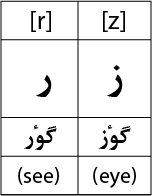
The sound [r] signifies: acting, dynamicity, motion
The sound [z] signifies: fixedness, staticity, firmness