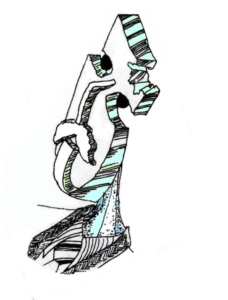
Sound: [l]
Signifying:
-
-
-
-
-
- form/type (rare): (of) converting, shifting
- (functionally) transitive, converting, transferring, transformative
-
-
-
-
Place of articulation: front of the tongue and the alveolar ridge
manner of articulation: lateral-approximant
voiced/voiceless: voiced
Our studies show that the early sounds were of semiotic values. Therefore, we use signify semiotically (instead of sign) for the sounds. The semiotic value of the lateral-approximant sound [l] is:
[formally/typically] (of) converting, trans- nature
(as action) trans-, convert
(functionally) transitive, converting, transferring, transformative
Points with the sound [l] in the phonetic/phonemic system:
- There are specifically two alphabets which their graphic shapes are of semiotic value. Therefore, we can consider the graphic forms of the sound [l] in the Greek alphabet Lam[b]da and in the Abjad alphabet lam:
Greek lambda [l] Upper case: Λ and lower case: λ
Abjad lam [l]: ل
They are quite clearly semiotic icon signs signifying trans- and converting concepts.
- Other than the mentioned functionality of the sound [l] in word formations in Türki language, its role and function as a converting or a shifting signification is obvious:
a. to change an active voice to a passive voice in the form of [vowel + l]
b. to convert a noun into a verb in the form of [l + vowel]
c. to convert an adjective into a verb in the form of [vowel + l]
- The sound [l] is rare to come as the first sound in a word formation because it does not signify any form!
- The sound [l] has had complexity with the sound [r] since the early phases of language and it is still possible to be found. This complexity is due to the significations they convey.
[l] trans-, shifting, converting
[r] active, dynamic
Because of the above functionalities with both sounds their coming at the beginning of a word is rare in Türki since they can’t signify a form.