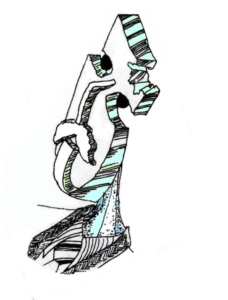
Sound: [g]
Signifying:
-
-
-
-
- form/type: (of) passing-motional nature
- (as action): (of) passing-motional nature
- (functionally): ?
-
-
-
Place of articulation: back of the toungue and hard palate
manner of articulation: stop/plosive
voiced/voiceless: voiced
The sound [g] as in göz (eye) in Turkish. This sound cannot be found in formal English.
The phonetic signs used here are in accordance with Türki sounds. Therefore, for example, the first sound in the English word girl _that is soft palatal_ is shown by [q]. This sign [g] is used for the hard palatal form of that sound.
Our studies show that the early sounds were of semiotic value. Therefore, we use signify semiotically (instead of sign) for the sounds. The semiotic value of the stop sound [g] is:
[formally/typically] (of) passing-motional nature
(as action) (of) passing-motional nature
(functionally): ?
Points with the sound [g] in the phonetic/phonemic system:
- This voiced sound [g] pairs with its voiceless [k] (hard palatal):
[g]: pass-motion
[k]: locality, stationary
- This pair make a system with their soft palatal forms:
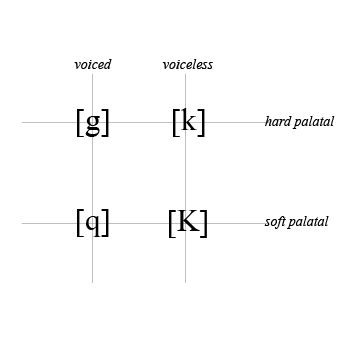 This pair [g] and [k] have had complexity with the alveolar sounds [c] ([j]) and [ç] ([ch]) sounds respectively at early language phase!
[g-c] complexity
[k-ç] complexity