Örgənmək


1. sound-signify


Örgənmək: (verb) to learn

Sound-signify:

prominent form/type []:

vectorial tendency [ö]: (relative to) the depth/core of ‘dir’ [essence]

function [r]: dynamic, active, motional

[g]: (of) passing-motional nature

[vowel+n]: self-transitive

Sound-signify version: ([do the act] relative to the depth/core of ‘dir’ [essence]) + ([functionally] active) + (of passing-motional type) + (self-transitively)

Semantic interpretation: ([to] do self-transitively the active/dynamic job of passing-motional nature relative to the depth of essence)

Plain : ([to] do self-transitively make [some point] deeply)

Örgətmək: (verb) to teach

Sound-signify:

prominent form/type []:

vectorial tendency [ö]: (relative to) the depth/core of ‘dir’ [essence]

function [r]: dynamic, active, motional

[g]: (of) passing-motional nature

[vowel+t]: definite other-transitive

Sound-signify version: ([do the act] relative to the depth/core of ‘dir’ [essence]) + ([functionally] active) + (of passing-motional type) + (other-transitively)

Semantic interpretation: ([to] do other-transitively the active/dynamic job of passing-motional nature relative to the depth of essence)

Plain : ([to] do other-transitively make [some point] deeply)

background

Ör– and Öz are from the same origin. The reality of this origin is illustrated best with the graphic figures in so-called Arabic alphabet as: ر (r) and ز (z); (The same shape, without a dot resembles dynamicity while with a dot resembles staticity, ceasing dynamicity, stability, fixedness. Seemingly the dot has got some fixing function.)

See: öz
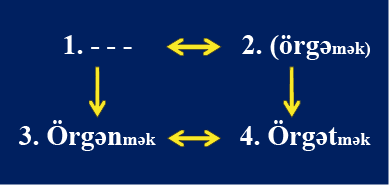

2. structure


base infinitives:

affirmative:

active: [1. —, , 2. (örgəmək) 3. örgənmək, 4. örgətmək]

mutual: [5. örgəşmək, 6. —, 7. —, 8. —]

causative: [9. —, 10. —, 11. —, 12. —]

mutual: [13. örgəşdirmək, 14. —, 15. —, 16. —]

passive: [17. —, 18. —, 19. örgənilmək, 20. örgədilmək]

mutual: [21. —, 22. —, 23. —, 24. —]

passive-causative: [25. —, 26. —, 27. —, 28. —]

mutual: [29. örgəşdirilmək, 30. —, 31. —, 32. —]


negative:

active: [33. — , 34. —, 35. örgənməmək, 36. örgətməmək]

mutual: [37. örgəşməmək, 38. —, 39. —, 40. —]

causative: [41. —, 42. —, 43. —, 44. —]

mutual: [45. örgəşdirməmək, 46. —, 47. —, 48. —]

passive: [49. —, 50. —, 51. örgənilməmək, 52. örgədilməmək,]

mutual: [53. —, 54. —, 55. —, 56. —]

passive-causative: [57. —, 58. —, 59. —, 60. —,]

mutual: [61. örgəşdirilməmək, 62. —, 63. —, 64. —]


adjective/noun:

örgənmə/ örgənməmə (n.)

[örgənməli/ örgənməməli] (adj.)

örgənmiş/ örgənməmiş (adj.)

[örgənmişlik/ örgənməmişlik] (n.)

örgənər/ örgənməz (adj.)

[-/ örgənməzlik] (n.)

örgənər/ örgənməz (repeating aspect)

[örgənərkən/ örgənməz ikən] (adverb)

örgənir/ örgənmir (progressive aspect)

[örgənirkən/örgənmirkən] (adverb)

örgənmiş/ örgənməmiş (perfect aspect)

[örgənmişkən/ örgənməmişkən] (adverb)

örgənəcək/ örgənməyəcək (future aspect)

[örgənəcək ikən/ örgənməyəcək ikən] (adverb)

örgən [ örgəncəgin] (adverb)

örgənər

[örgənərək: örgənər + ək] (adverb)

örgən

[örgəncəgin: örgən + cəgin] [örgənə örgənə] (adverb)

örgəniş (n.)

[örgənişli/ örgənişsiz] (adj.)


infinitive/ noun from infinitive:

örgənmək [örgənməgə, örgənməkdə, örgənməkdən, örgənməgi, örgənməgin]

[örgənməgəcən, örgənməkdə ikən, örgənməginki]

örgənmə [örgənməyə, örgənmədə, örgənmədən, örgənməni, örgənmənin]

[örgənməyəcən]

örgəndik [örgəndigə, örgəndikdə, örgəndikdən]

[örgəndikcə, örgəndikdə ikən]

örgəndi [örgəndiyə, örgəndidə, örgəndidən, örgəndini, örgəndinin]

[örgəndiyəcən]

Leave a Reply

Your email address will not be published. Required fields are marked *

Fill out this field
Fill out this field
Please enter a valid email address.
You need to agree with the terms to proceed

keyboard_arrow_up
